7. Last contract
[To access the article “Guizot et ses éditeurs” in PDF format in French, click here. To read it online, follow the sequence of pages in the navigation menu.]
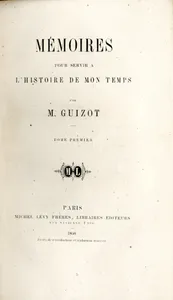
Michel Lévy was thirty-one when, in 1852, he moved to 2 bis rue Vivienne the bookshop founded by his father Simon in 1836, which had become a prominent publishing house. The file I present and discuss here contains ten contracts signed with Guizot. Guizot’s correspondence, and the archives of the Calmann-Lévy publishing house, show that Michel Lévy, since at least 1855 and probably earlier, had formed ties with him and his family that grew closer over time{{1}}[[1]]From the summer of 1867, M. Lévy addresses him as “dear Mr Guizot” rather than simply “Sir”, expresses his “most affectionate and devoted sentiments”, and asks to be remembered “to the inhabitants of Le Val-Richer”.[[1]], far more closely than with Didier. To Didier, a publisher in the literary and historical tradition, Guizot had never thought of entrusting the publication of his political works, which is why it is surprising that he did not take the trouble, and that Didier did not ask him, to cancel article 2 of the 1850 contract earlier. Indeed, it was to this undertaking that, as early as 1854, Guizot was determined to apply himself, postponing sine die the writing of the fourth part of the Histoire de la révolution d’Angleterre. A first contract, for a volume on the origins and effects of religious freedom in Christian Europe, was signed on 21 March 1857 with “Messieurs Michel Lévy, frères”, for Michel also represented his elder brother Calmann, who kept more in the background; but it came to nothing. The main business was concluded three days later, in the form of an agreement very simple in its provisions but very substantial in its content. Guizot assigned, for twelve years from the release of the last volume, the ownership of his entirely unpublished Mémoires pour servir à l’histoire de mon temps, covering the period 1814-1848, in at least four volumes, the manuscript of each to be delivered from 1858 onwards “so that the work may be completed in 1862 at the latest”, that is, at least one a year. The flat-fee price was set at 20,000 francs per volume for the first three, at 12,000 for the fourth, and the same for a fifth “should the work contain too much material to fit into four volumes”. Half the sum due would be paid in cash on delivery of the manuscript, and the balance in two notes falling due three and six months after the “passed for press” of the last sheet of the volume concerned. English-language rights were reserved to the author. Not counting the £1,200, or nearly 25,000 francs, to which Richard Bentley had committed himself by contracts of 1 May 1857 and 8 May 1860{{2}}[[2]]Memoirs to illustrate the history of my time. Translated by John William Cole.[[2]], it was at least 72,000 francs, a sum unprecedented for him, that Guizot could expect from this Herculean labour, which at 70 he thus undertook with a light heart.
And the old athlete rose to the challenge, since by 1862 five volumes had appeared in succession. And yet he had only reached the beginning of 1840. Three more volumes were still needed. If a new contract was signed with Michel Lévy at that time, it is not in the file. But supposing these last three volumes were paid at the same rate as the fourth and fifth, Guizot would have drawn a total of 120,000 francs from this great undertaking. A pause was called for. By a contract of 21 March 1861, Guizot sold Lévy, under the ambitious and overstated title of Histoire parlementaire de France, the right to publish his Discours aux chambres, in four volumes forming a complement to the Mémoires. Guizot undertook to provide linking texts which “give, so to speak, the thread of the history of the parliamentary regime under the government of King Louis-Philippe”. At the head would be placed a new introduction of between one hundred and two hundred pages, entitled – though the contract does not specify this – “Trois générations, 1789, 1814, 1848”{{3}}[[3]]In 1863 M. Lévy published this introduction separately in octodecimo format, at the same time as the first three octavo volumes of the Discours appeared.[[3]]. The agreed sum was 4,000 francs per volume, payable on the same terms as the Mémoires. In a new profit-sharing clause, a “bonus” of 1,000 francs per volume would be paid as soon as sales – and not the print run – exceeded 3,000 copies. It was specified that if one or more additional volumes proved necessary, they would not be paid for. The publisher thus saved at least 4,000 francs, for a fifth volume was indeed required, the whole appearing in 1863-1864. Publication of the Mémoires could then resume, and was completed in 1867. In ten years, thirteen volumes had thus been put on the market.

In the meantime, Guizot had not been idle, turning actively to religious questions. On 24 August 1861, he assigned to M. Lévy, for twelve years, the rights to what might be called a work of intervention, entitled L’Église et la société chrétienne en 1861. The manuscript, which Guizot had in fact begun writing in May, was to be delivered two weeks later; and so it was. The price was set at 1 franc 25 per octavo volume printed and 50 centimes for the octodecimo format{{4}}[[4]]Article 2 stipulates that typesetting is to use “the same measure as the edition of M. Renan’s translation of the Song of Songs, published by MM. Michel Lévy frères.” It is rare for Guizot to follow Renan’s lead.[[4]], with 10,000 francs paid for a first print run of 8,000 copies, half in cash on delivery of the manuscript, half at three and six months. It was specified that “the double overs customary in the book trade” would not be paid for, but it emerges implicitly from article 6, on payment, that they were not counted in the print run. The publisher could publish the work in Germany – and thus in French – without owing anything to the author, to whom, as usual, the English-language rights were reserved, the others belonging to Lévy. It was on the same terms that a contract was concluded on 7 December 1863 for a volume of Méditations sur la religion chrétienne, the fee rising from 1 franc 25 to 1 franc 50 if the volume exceeded 400 pages, with an option on further Méditations under the same conditions. Indeed, two volumes followed the first, published in mid-1864{{5}}[[5]]After the Méditations sur l’essence de la religion chrétienne (1864) came the Méditations sur l’état actuel de la religion chrétienne (1866) and the Méditations sur la religion chrétienne dans ses rapports avec l’état actuel des sociétés et des esprits (1868).[[5]], making in all four substantial works, all from Guizot’s own pen. And that is not all: by contracts of 20 February 1868 and 15 March 1869, and on identical terms – 4,000 francs, half in cash, half at three and six months – M. Lévy acquired the ownership of two collections of articles whose contents were not specified, respectively the Mélanges biographiques et littéraires and the Mélanges politiques et historiques{{6}}[[6]]The first collection brings together notices of very uneven length on Edward Gibbon, Mme de Rumford, Mme Récamier, the Comtesse de Boigne, Princess Lieven, M. de Barante, M. de Daunant, and Philip II and his new historians. The second collection brings together six essays and articles published between 1816 and 1828.[[6]], each accompanied by a new preface. Finally, following three Lévy contracts dated 24 March 1857, 25 January 1860 and 8 June 1861 respectively, ten volumes had been published in translation under Guizot’s auspices, each work including{{7}}[[7]]Histoire de la fondation de la République des Provinces-Unies by John Motley, 4 vols., 1859-1860; La Chine et le Japon by Lawrence Oliphant, 2 vols., 1860; William Pitt et son temps by Lord Stanhope, 4 vols., 1862-1863. To these must be added, under a contract unknown to us, Le Prince Albert, son caractère, ses discours, in a translation by Henriette de Witt preceded by a substantial preface by Guizot, in 1863.[[7]] a preface by him of at least 32 pages, for assignment fees totalling 10,000 francs. For Michel Lévy as for François Guizot, though for different reasons, this decade of 1858-1869 was a publishing prodigy, both for the enormous mass of texts supplied{{8}}[[8]]To this must be added a foreword to a new edition of Chateaubriand’s Génie du christianisme, in two volumes, published by M. Lévy in 1866, and a short work drawn from a long article published in September 1869 in the Revue des deux-mondes, La France et la Prusse responsables devant l’Europe, printed in 5,000 copies paid at 15 centimes each.
[[8]] and for the no less considerable sum paid for them during this period, since Guizot had received at least 200,000 francs for the French language alone – perhaps, though any conversion is very hazardous, around one million euros. That creates bonds, in both directions, and the trust between Michel Lévy and Guizot was never to be impaired, even though Guizot turned to the house of Hachette for his very last works.
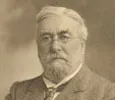
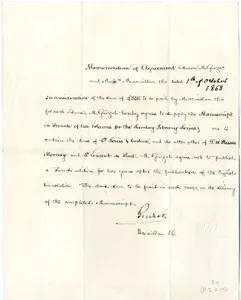
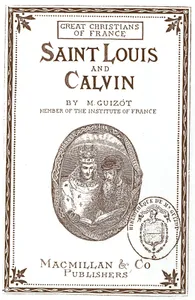
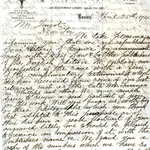
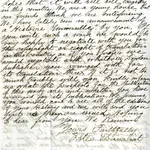
Set against this tidal wave, the book that resulted from the last contract signed by Guizot, on 13 April 1872, may seem insignificant. But it was not so for its author, who organised its publication in an original way. He had in fact received a very long and most surprising letter, dated 10 June 1867, from Alexander Macmillan, who in 1843 had founded, with his brother Daniel, grandfather of the Prime Minister Harold Macmillan, a publishing house located at 16 Bedford Street, Covent Garden. In this missive, Mr Macmillan, now sole head of the firm, introduced himself at great length: his origins and strong Scottish identity, his mother’s piety, the death of his excellent father when he was seven, his upbringing in keeping with the tradition of his country, with observance of the Sabbath day and improving Sunday reading, in particular John Bunyan’s The Pilgrim’s Progress, his schooling in Glasgow, his beginnings in London alongside his brother Daniel, a bookseller’s clerk, and their setting up in business on their own account. After this interminable captatio benevolentiae, he came to the point: to secure Guizot’s collaboration for a series of books intended for Sunday reading, entitled “Sunday Library of the Households”, whose spiritual influence on the public would be served by an attractive presentation and the names of distinguished writers. He thus cited, among his recruits, Charles Kingsley, Thomas Hughes, author of the famous Tom Brown’s School Days, and, more to the point, Charlotte Yonge, who had made her name with her novel The Heir of Redclyffe, and Dinah Craik, noted for John Halifax, Gentleman, whose husband George was Macmillan’s partner. Indeed, these two novelists of unimpeachable morality had become friends of Henriette de Witt, who had translated, and would go on to translate, some of their works into French, and they were regular guests of the Guizots, including at Le Val-Richer. The very next day, Frances Martin, Macmillan’s editorial collaborator, took over, suggesting that Guizot write the lives of Saint Louis, St Dominic and St Francis. The last two could hardly suit Guizot, and they settled on Saint Louis and Calvin, Duplessis-Mornay and St Vincent de Paul – two Catholics and two Protestants. A Memorandum of Agreement was signed on 1 October 1868, under which Macmillan would pay £350 for each of the two volumes, the first containing the lives of Saint Louis and Calvin, the second those of Duplessis-Mornay and St Vincent de Paul, on delivery of each of the two manuscripts, written in French. The author undertook not to publish the French edition less than two years after the English one appeared. When the contract was concluded, the writing of the first volume was already well advanced, so that the end of the manuscript of the first volume reached Mrs Frances Martin in January 1869; she was responsible for the translation, which Guizot checked as it went along, and then in proof. Their intensive collaboration, which took the form of a sustained correspondence, made it possible to publish, at the end of the year, Great Christians of France. Saint Louis & Calvin, by M. Guizot. The latter then postponed the second volume sine die.
In the spring of 1872, the two years of English exclusivity having run their course, Guizot asked Templier whether Hachette would be interested in a French edition. The offer was immediately accepted, and a contract was signed on 13 April by Guizot and Georges Hachette for Les Vies de quatre grands chrétiens français, in two volumes, each paid at one franc per copy for the octavo format, priced at 7 francs 50, with an initial print run of 1,500, and fifty centimes for the octodecimo Jésus format, priced at 3 francs 50 and to be the subject of a later edition of 4,000 copies. The publisher reserved the right to publish each biography separately, with a first print run of at least 5,000 copies paid at 15 centimes each. Guizot pointed out that a translation of the first volume had already appeared in English, and that he reserved the right to publish its sequel in that language, before the French publication and for his exclusive profit. Finally, the manuscript of the first volume was to be delivered on 1 July, proof that Guizot wished to revise and adapt his text for the French public. The 376-page octavo edition, with a short preface, appeared at the beginning of 1873. It seems that no other was ever produced.
Thus, with Guizot’s life itself, his activity as an author came to an end. Publishers believed him eternal, since on 25 April 1874, less than five months before his death, the Boston firm of Estes & Lauriat, having heard that he was preparing a “Universal History” – no less –, was still putting itself forward for the English edition. This project existed only in the minds of these gentlemen, but it bore witness to the standing of one of the most renowned authors of the century. From the 1808 agreement with Maradan to the 1872 contract with Hachette, a whole world had turned around an intellectually unsinkable Guizot. From copy paid by flat fee to payment per copy based on the print run, from payment in gold coin to a cheque drawn on a London bank, from the appearance of overs and advertising to the sharing of proceeds from foreign rights, from expensive editions to very cheap books and sale in instalments, from bread-and-butter work to a magnum opus fiercely negotiated, from the bookseller Brière’s shop to the Hachette firm with nearly 400 employees and a capital of ten million, Guizot, in sixty-four years, had watched the publishing trade develop and transform itself, contributing to it in his own way through his material demands, his understanding of the publishing business, and both the vastness and the quality of his writings. He lived by publishing, just as he helped publishing to live.
Laurent THEIS