Guizot and his publishers
[To access the article “Guizot et ses éditeurs” in PDF format in French, click here. To read it online, follow the sequence of pages in the navigation menu.]
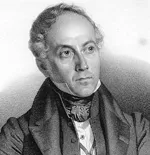
Orphaned and without fortune, raised in straitened circumstances, François Guizot (1787-1874) lived for the most part, throughout his long career, on the proceeds of his intellectual and literary work. The least one can say is that politics, which he practised between 1814 and 1848, not without interruptions, in various capacities – senior civil servant, deputy, ambassador and minister – and right up to the summit of power, did not make him rich. The second half of his life in particular took the form of a long, studious retirement, by temperament but also out of necessity. In contrast with his early and enduring fame and the great responsibilities he had held, the modesty of his way of life struck his contemporaries, who were unanimous in praising his disinterestedness. When, at the end of the Second Empire, Alfred de Falloux climbed the stairs to visit him in his small fourth-floor apartment on the rue Billault, he gasped: “My respect for him grows with every step.”
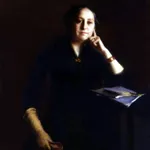
It was therefore chiefly with his pen that the historian and statesman obtained the resources he needed for himself and, above all, for his family, whom he moreover closely involved in his writing activity, in particular his eldest daughter Henriette de Witt-Guizot{{1}}[[1]]Cf. François Guizot, Lettres à sa fille Henriette (1836-1874), edition introduced and annotated by Laurent THEIS, Paris, Perrin, 2002. See the biographical essay on Henriette de Witt-Guizot by Catherine COSTE at the beginning of the volume.[[1]]. More than fifty titles, making up over one hundred and fifty volumes, appeared under his name, most of them as author, others under his direction or authority.
His relations with publishers were thus of particular importance, and he maintained them with great care; publishers, some of whom emerged on the intellectual scene at roughly the same time as Guizot, and whose practices evolved throughout the century, altering the dialogue between publisher and author in a book economy undergoing profound transformation. Yet he was one of the most prominent writers for two-thirds of the nineteenth century, the number of copies of his works sold amounting in all likelihood, in the absence of precise figures, to several hundred thousand.
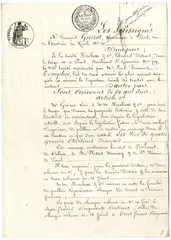
François Guizot’s private archives{{2}}[[2]]I am most grateful to Mrs Catherine Coste, president of the Association François Guizot, for kindly placing these entirely unpublished documents at my disposal.
[[2]] contain thirty-eight contracts concluded between 1808 and 1872 with twelve different French publishers out of the seventeen with whom he dealt, as well as half a dozen contracts for the English language – in all, therefore, nearly two-thirds of the commitments he entered into over 64 years. These legal and financial instruments are sometimes accompanied by the correspondence that preceded and followed their signature, mainly with the houses of Didier, Lévy and above all Hachette, as well as with an English translator. These exchanges, which take us into the details of the negotiations, show that publishing relationships were far from smooth. To these are added statements recording reprints and new editions, together with their print runs.
Certain enduring features emerge from this body of documents. Thus, the term contrat is never used. The most common is the long-established term traité, more rarely convention, whose provisions, as set down on paper, are sometimes referred to at the foot of the document as l’écriture, approved by author and publisher – this latter trade designation (éditeur) first appearing alongside, then gradually replacing, that of bookseller (libraire). Moreover, the legal and financial clauses of all the agreements, although they changed and became more precise over time, as did the balance of power, relate exclusively to the volumes, tomes and copies printed, never to those sold, with a single exception, which moreover came to nothing{{3}}[[3]]This refers to the draft contract with Napoléon Chaix in 1851. See below.
[[3]]. Finally, the practice of an advance on royalties appears nowhere here. Delivery of the manuscript, whether partial or complete, is alone what gives entitlement to payment. In this respect Guizot stands apart from contemporaries such as Chateaubriand or Lamartine, who sold plans for works they had not yet written, thereby pledging both their credit and their freedom.