1. A promising start
[To access the article “Guizot et ses éditeurs” in PDF format in French, click here. To read it online, follow the sequence of pages in the navigation menu.]
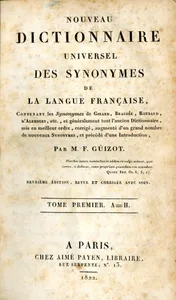
The first book bearing the name of François Guizot was the subject of an agreement signed on 15 March 1808 with the bookseller Claude François Maradan (1762-1823), who kept a shop at 9 rue des Grands Augustins in Paris. This was the Dictionnaire universel des synonymes de la langue française, an already long-established publication which Maradan had acquired and on which he wished “to bestow all the perfection of which it is capable” by adding “an introduction of some length” and new synonyms, “the whole to form an increase of approximately 200 to 250 pages in the new edition.” For this purely bread-and-butter work, which was to be – and indeed was – completed by 1 January 1809, Guizot, referred to as “the author”, was to receive 1,800 francs, half in cash upon delivery of each of the three volumes – in fact reduced to two –, and half in monthly instalments of 100 francs from the first month after printing was completed. The sum was far from negligible for a 20-year-old beginner. It is true that he enjoyed the backing and support of the novelist and essayist Pauline de Meulan, his future wife, who had had publishing dealings with Maradan for at least ten years. Nine editions of the Nouveau dictionnaire universel were to follow one another until 1885. In addition to the new 13-volume edition of Gibbon, whose contract, which included Pauline de Meulan, had been concluded in October 1808 for a fee of 5,400 francs{{1}}[[1]]Published in 1812, this edition was reprinted in 1819 and in 1828.[[1]], Maradan went on to publish three more works by Guizot up to 1816, whose contracts have not come down to us.
The 1808 agreements provided for a purely flat-fee payment, taking no account of sales, or even of any reprints that success might bring, the profit from which would go exclusively to the publisher. On this point, the agreement signed on 31 March 1812 with Frédéric Schoell (1766-1833), a German who had settled in Paris in 1802 at 29 rue des Fossés-Saint-Germain l’Auxerrois, better protected the interests of the author, by now established in the world of letters. For three volumes of Vies des poètes français du siècle de Louis XIV, with a first print run of 1,500 copies, the author was to receive 3,600 francs. As was often the case in the nineteenth century, the work was to be sold in instalments, in this case twelve of about one hundred pages each, to be delivered monthly from October 1812. A sum of 150 francs would be paid on delivery of each manuscript, and another 150 six months later. In clauses that did not appear in the earlier surviving agreements, the author was to receive twenty free copies and, above all, each new edition, with the same print run, would earn him 1,800 francs, payable in three instalments. The relationship between publisher and author was thus more balanced. Guizot never received the full amounts stipulated, for only the first volume appeared, in 1813, devoted to Corneille, Chapelain, Rotrou and Scarron, the last three being written by Pauline de Meulan and signed with her initials alone, unlike the Corneille. Another innovation that was to have a sequel: when Guizot, a young married man decidedly short of income, contracted in July of that same year 1812 with Johann Friedrich von Cotta (1764-1832), heir to an old line of booksellers established in Stuttgart, for a revision of the abbé Mozin’s Nouveau dictionnaire complet à l’usage des Allemands et des Français, he asked to be paid in German books to the value of one thousand francs, out of the six thousand agreed. Similarly, the agreement concluded on 30 October 1820 with the bookseller Alexandre Lequien, of 25 rue des Noyers, for a new thirty-tome edition of the works of Rollin with notes by Guizot – who had just been dismissed from the Conseil d’État and was going over to the opposition – included, besides a fee of 4,000 francs in ten instalments, a copy of Voltaire’s works in 70 volumes, then in the course of publication, and likewise of the 20 volumes of Rousseau still to come; or how to build up a library.

The many contracts signed by Guizot during that highly productive period, the second half of the Restoration, do not appear in the Guizot archives; this is the case for the three political essays and pamphlets published by Ladvocat, and a fourth by Béchet, for the two enormous undertakings, published by Brière and Béchet respectively, the Collection des mémoires relatifs à l’histoire de France, in 30 volumes, and the Collection des mémoires relatifs à la Révolution d’Angleterre, in 25 volumes, both launched in 1823, and also for the first two volumes of the Histoire de la Révolution d’Angleterre, published by Leroux and Chantepie. It is therefore only through a contract signed on 14 August 1838 with Charles Gosselin (1792-1859), of 9 rue Saint-Germain-des-Prés, publisher of Lamartine, Vigny, Balzac and other celebrities, that we can gauge the changes that had taken place in publishing practices. Explicit mention is thus made not only of the copies intended for the author, but also of those sent to newspapers, testimony to the growing role of the press in launching a book. To these is added the “thirteenth free copy”: when a bookseller ordered twelve copies, the publisher gave him a thirteenth as a commercial gesture. All of these copies outside the trade, on which the author received no payment, were set at the considerable proportion of 200 per 1,000. Moreover, the work was to be printed in two formats, octavo and duodecimo, in runs of 2,000 and 2,500 copies respectively, paid at two francs each for the former and fifty centimes for the latter upon publication. To combat foreign counterfeits, a growing scourge chiefly in Belgium, a French-speaking country that had appeared on the political map of Europe only eight years earlier, the publisher envisaged additional print runs bearing the words “special edition”, not to be sold in France, for which the author would be paid 40 and 20 centimes according to format. The publishing rights, it was specified, were granted for five years from the work’s publication, and the author would receive fifty free copies. This contract, signed by Guizot during one of the rare intervals between his ministries under the July Monarchy, and covering a Histoire de France for the education of his children in four or six large volumes, never took effect with Gosselin{{2}}[[2]]Guizot did, however, publish with Gosselin, in 1840, the six-volume translation of Vie, correspondance et écrits de George Washington. The substantial introduction he wrote for it was reissued separately, again by Gosselin, self-styled “publisher of the library of the elite”, in 1842.[[2]]. But it sheds light on the refinement of contract law, with the introduction of clauses that were more precise, more protective of the interests of both parties, and also better attuned to the economic stakes.