2. From Didier to Masson
[To access the article “Guizot et ses éditeurs” in PDF format in French, click here. To read it online, follow the sequence of pages in the navigation menu.]
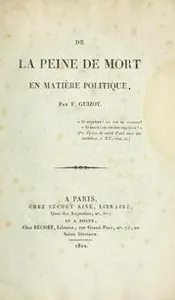
On 1 January 1839, Guizot signed a contract of two short articles granting Didier, for six years, the right to publish his Cours d’histoire moderne of 1828-1830, in other words his Histoire de la civilisation. It was to bring him 7,200 francs, payable in six instalments of 1,200 francs between 1839 and 1844: an old-style agreement, in short, but a rather lucrative one. It is true that this course was to be republished at least nineteen times in the nineteenth century, up to 1882, by Didier and then by his successor Émile Perrin. This was not the beginning but one stage in a collaboration that lasted nearly thirty-five years. Born in 1800, Pierre-Paul Didier had founded in Paris in 1828 an academic bookshop intended chiefly to publish the lectures of the professors of the Faculté des Lettres. Together with Jean-Armand Pichon, who had obtained his bookseller’s licence in 1827, he had taken over part of the business of François Béchet Aîné, and had thus published a first edition of the Cours d’histoire moderne in six volumes between 1829 and 1832, as well as a new edition of De la peine de mort en matière politique in 1828. It was then, at the latest, that Guizot had met him. Since 1832, Didier had been publishing under his own name and on his own account, at 35 quai des Augustins. On 7 February 1840, in the same spirit as the previous year’s contract, Didier acquired for four years the right to reprint what was already, in France and in England, a standard work, the two volumes of the Histoire de la Révolution d’Angleterre, in 4,000 copies, for the sum of 8,000 francs payable over two years. Besides measures against Belgian counterfeiting, explicitly named, the agreement contained a right-of-preference clause: at the end of the four years stipulated, and “at an equal price”, Didier would be preferred over any competitor, not only to reprint these two volumes but also to publish their sequel, which promised to be substantial since Guizot had from the outset made known his intention of continuing his account up to 1688. This agreement, which ran to twenty-five lines and was signed almost in passing, was later to contribute to a serious deterioration in relations between Didier and Guizot.
In the meantime, Guizot had embarked on a venture that was to end ingloriously. Approached by the attorney Gabriel Bodiment, who, like others, had professed his admiration for him, he had concluded two agreements with him on 22 November 1839, even though Bodiment was not a genuine professional of the book trade. The first concerned three volumes of Mélanges historiques et politiques, to be delivered within one year. Bodiment acquired the publication rights for four years, at a price of 4,000 francs per volume payable on delivery of the manuscript, for a print run of 3,500 copies, after deduction – and this was something new – of the “mains de passe”, that is, the allowance for spoiled sheets. A complicated system of forfeits and repayments in the event of failure to meet the deadline, covering all or part of the work, showed that neither party was confident the undertaking would succeed. Similar clauses appeared in the second agreement, which was even more ambitious: Mr Guizot having “expressed his intention of writing a history of Mirabeau”, Bodiment acquired the publication rights to this volume, to be delivered within two years. Should the author decide to extend his work into a history of the Constituent Assembly in two, three or four volumes, this time to be delivered within four years, “and perhaps even later the history of the Convention and the Directory”, Bodiment would buy the rights on the same terms. He undertook to print 17,000 copies, to be attested at the author’s request – one can never be too careful – by a declaration signed by the printer, and each volume was to be paid 20,000 francs, a considerable sum, perhaps a little too good to be true, hence once again an abundance of precautions in case the deadlines were overrun. Bodiment, unable to finance such an operation, went into partnership as early as 25 November with the young banker – he was 31 – Mariano de Bertodano, a fine name for an adventurer, who among other activities was director of the Compagnie Corse, which exploited forests on the island. Bertodano was to provide the necessary capital, up to a limit of 60,000 francs, while Bodiment took charge of publication. The exorbitant commitments made by Guizot, who returned to government a year later, were naturally not honoured, since he delivered only the manuscript of half of the first volume of the Mélanges, whose printing was begun, and the affair turned sour, all the more so as Bodiment died in 1840. In 1843, after hard negotiations, Guizot was obliged to repay Bertodano 5,400 francs he had received in December 1839 and January 1840 as an advance, which the contract had not provided for, and to pay him 2,866 francs in compensation for the cost of paper and printing. On 18 March 1844, an agreement was reached between the two parties in full and final settlement. The author, minister though he was, and no doubt anxious to keep the affair quiet, had not had the last word.
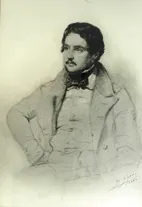
On 24 February 1848, the revolution made Guizot an exile in England. Having left empty-handed and settled with his family at 21 Pelham Crescent in Brompton, then a suburb of London, he felt a pressing need for money, which essentially only his pen could meet. He therefore immediately resumed his work, in particular the Histoire de la Révolution d’Angleterre, the rights to whose first two volumes, held by Didier under the 1840 agreement, he had recovered in 1845, and also the Histoire de la civilisation, which Didier had continued to exploit regularly, with reprints in 1845 and 1846, and to which Guizot intended to write a sequel. As far as the facts can be reconstructed, he asked his loyal friend Charles Lenormant to find him a publisher in France who would offer him the best terms. Lenormant, at Guizot’s request, began by approaching Pierre-Paul Didier, whom he apparently did not consider financially sound enough to provide Guizot with the large sums he was seeking. The conversation between the two men went badly, and Didier was later to claim that Lenormant had been insulting, “treating him like a little boy, like a poor devil who could not pay 50,000 francs cash down in 1848{{1}}[[1]]Letter of 2 February 1855 to Auguste Génie.[[1]].” This very high figure was, Lenormant asserted, the one offered in writing by a competitor reputed to be more enterprising, Masson. Born in 1807, Victor Masson had been taken on as a clerk by Louis Hachette in 1833. After a partnership with the bookseller Nicolas Crochard to run the Librairie médicale et scientifique, he set up on his own account and under his own name in 1846, at 17 place de l’École de Médecine, and, while styling himself “Bookseller to the learned societies attached to the Ministry of Public Instruction”, sought to broaden his list. Guizot would be a prize recruit for him, and it was therefore to Masson that Charles Lenormant steered his “illustrious friend”, who negotiated the terms of a contract directly; it was signed on 24 November 1848 in Brompton, where Masson thus seems to have travelled expressly for the purpose.
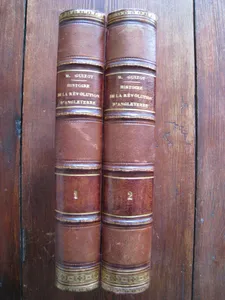
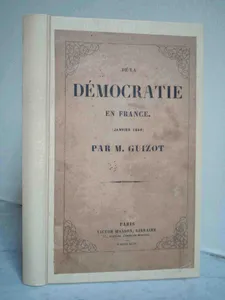
This eleven-article document is of the greatest interest, so evidently have its clauses been weighed to the last grain. While the financial terms granted to Guizot were unprecedented for him, the publisher hedged them about with precautions hitherto unknown. Added to these were new elements compared with the contracts available to us: a deluxe issue of 25 copies on vellum paper for the author, and above all the retention by the author of all rights for the English language, it being understood that this foreign edition “may not appear a single day before the publication of the French-language edition”; this reservation of English-language rights would henceforth appear in every contract signed by Guizot, who considered himself, thanks to his many connections across the Channel, best placed to look after his own interests. Indeed, his major works, and others too, were translated into English at short notice, and sometimes achieved great commercial success, thus producing substantial income that the author did not wish to share with his French publisher. Finally – and this article would often recur in later agreements – the assignment of rights granted by the author to the publisher could not prevent the texts concerned from being included in any future Œuvres complètes, provided they were not presented separately and a certain interval was respected. Guizot thus sold Masson, for twelve years, the publishing rights to the first period of the Histoire de la Révolution d’Angleterre (1625-1649), already published by Didier, together with a new introduction to be delivered “at the earliest possible date”, and to the second period (1649-1660), which Guizot proposed to write and deliver by 15 July 1850 at the latest. Should he write the third period (1660-1688), Masson would benefit from the right-of-preference clause. In payment for this assignment, the author was to receive 20,000 francs on delivery of the introduction, and the same amount on delivery of the second period. It was therefore to 40,000 francs, and not 50,000 as Lenormant had allegedly told Didier, that Victor Masson had committed himself; and even then he had nothing to pay immediately. Did he suspect that Guizot, who at the time did not rule out the idea, or even the hope, of returning to politics, would not keep to the agreed timetable? He was at any rate well placed to do so since, on 21 December 1848, he signed a contract with his new author assigning to him for eight years, for 4,000 francs on delivery of the manuscript, the ownership of a political essay of 130 to 150 pages entitled De la démocratie en France. Janvier 1849. Guizot was then putting the finishing touches to this highly ideological work, from which he expected a great deal, and which did indeed appear the following January and was snapped up within a few weeks, selling more than 20,000 copies. Despite the publisher’s Shakespearean self-congratulation – “My conscience tells me that I had made suitable offers, but when it is a question of being or not being Mr Guizot’s publisher, I cannot hesitate{{2}}[[2]]Letter to Génie of 17 December 1848.[[2]]” – this hastily concluded agreement had come cheap. Guizot found himself delayed in his main work, as Masson had foreseen, and indeed as Guizot himself had. The latter had in fact agreed that, if the manuscript of the second period was not delivered by 15 July 1850, the publisher “would be vested, from that day and without any formal notice being necessary, with the right to publish an edition of the Histoire de la civilisation as published by the bookseller Didier in five volumes”, in 6,000 copies, and without any royalties being due to the author, “by way of compensation for the loss caused to him by the delay” in delivering the manuscript. And this right was granted to him until October 1855. Finally, if the manuscript of the second period was never delivered to him – Guizot being barred from offering it to any other publisher at any time whatsoever – Masson “would find himself vested with absolute and unlimited ownership of the history of the first period”, and no longer for twelve years only. The leonine character of these articles 8 to 10 was exorbitant, and if Guizot accepted them, it was either because he was truly short of money, or because he imagined he would soon regain his seat as a deputy, and perhaps better still, or because he overestimated his strength, great though it was. Pierre-Paul Didier, who was to bear the cost of the planned compensation even though he had until then fulfilled his obligations, later complained bitterly of the treatment he had suffered, and asserted that Guizot had allowed himself to be manipulated by the enterprising Victor Masson. It is true that Didier himself had omitted, “through inadvertence” as he put it, to include in the 1839 contract for the Histoire de la civilisation a right-of-preference clause which, he would claim, had in his mind gone without saying, so much was the course in modern history “like a child of the house to me, and it could never have occurred to me to part with it{{3}}[[3]]Ibidem.[[3]].”
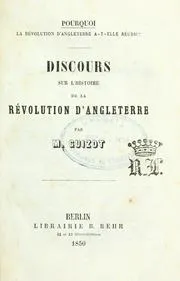
Things turned out as Masson had foreseen. On 26 January 1850, he published the fourth edition of the two volumes of the first period, preceded by an introduction entitled Pourquoi la révolution d’Angleterre a-t-elle réussi ? Discours sur l’histoire de la révolution d’Angleterre. Of this magnificent text, perhaps the most accomplished and densest Guizot ever wrote, Masson simultaneously published a separate edition of 180 pages, which, immediately translated by Sarah Austin, a very close friend of Guizot’s, appeared shortly afterwards in London, published by John Murray. Here again the success was resounding. But 15 July was approaching, and the manuscript of the second period had barely been begun. Masson was inflexible: in 1851, by way of “compensation”, he brought out the five volumes of the Histoire de la civilisation in octavo and sextodecimo formats. In three years he had pulled off a superb three-stage coup, while in reality paying out only 24,000 francs. Guizot had fared less well. He never did business with Victor Masson again.