Punctuation
Letters from François Guizot to his daughter Henriette
Friday 28 June [1839] – 8 o’clock
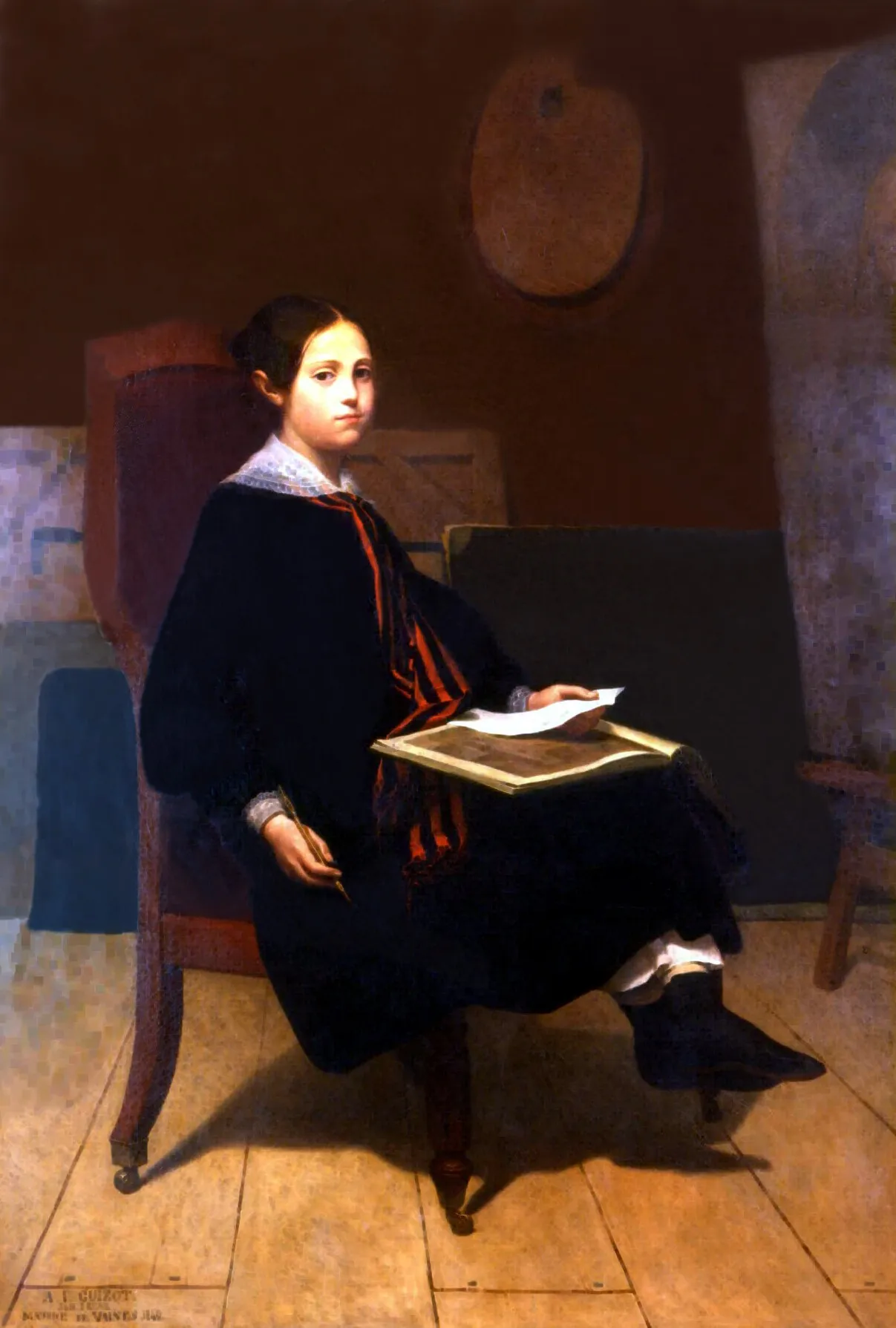
My dear Henriette, I must once again do battle with you over punctuation; there is none, or almost none, in your letters. The sentences follow one another without any distinction or separation, like the words of a single sentence. Even if this had no other drawback than to cause, at every moment, a kind of perplexity and surprise in reading your letters, that would be reason enough for you to mend your ways and punctuate like everyone else. But there is a more important reason, and one you will understand, I am sure. You have a very quick mind; you understand quickly and you act quickly. And as soon as you have understood or done something, you do not pause at all; you want to move on that very instant to something else. That is why you do not punctuate. All punctuation, comma or otherwise, marks a rest for the mind, a pause of greater or lesser length, an idea that is finished, or suspended, and that one separates by a line from the one that follows. You suppress these rests, these intervals; you write as water flows, as the arrow flies. That is no good, for the ideas one expresses, the things one speaks of in a letter, are not all absolutely alike, nor all intimately bound to one another, like drops of water. Between ideas there are differences, distances that are unequal but real; and it is precisely these distances, these differences between ideas, that punctuation and its various signs are meant to mark. In suppressing them, therefore, you do something absurd; you suppress the natural difference, the natural distance, that exists between ideas or things. That is why the mind is astonished and jarred in reading your letters; the lack of punctuation spreads over everything you say a certain deceptive uniformity, and robs the things you speak of of their true features, their true place, by presenting them all in a single stroke and as perfectly alike or contiguous.
But here is something more serious still. Quickness of mind, my dear child, is a quality, and a precious one. There are so many things to learn, to see and to do in life, and we have so little time to devote to them, that one is very fortunate to have received from God the gift of that rapidity, that ease of intelligence, which allows one to understand much and do much in a short time, and consequently to acquit oneself better of the task of life. But every quality has a corresponding defect against which one must carefully guard. If it were a question of character, I would tell you that very energetic people often lack gentleness, and very courageous people prudence. That is no good. Pascal or La Bruyère, I do not quite remember which, said somewhere: “A virtue has its full merit and its full worth only when it is accompanied by the opposite virtue. Let firmness be gentle, let gentleness be energetic. Nothing is good and beautiful but what is complete, what one can consider and admire from every side.”
What is true of character and its virtues, my dear child, is equally true of the mind and its qualities. A quality must not become the source of a defect. Now, quickness of intelligence can lead to lightness of attention. When one understands easily, one does not always take the trouble to understand perfectly. When one runs very fast, one does not look, and consequently does not see all there was to look at or to see along the way. Precisely because you have an easy and quick mind, my dear child, you must oblige yourself to dwell on things, to examine them with care, and not to be content with the knowledge your mind gains of them at first sight. Otherwise, a great part of what there is in things would escape you; you would never know or do anything perfectly. And a great natural quality would make you fall into an unfortunate imperfection.
It is because of this natural quality of your mind that you do not punctuate. You go too fast; you pass too quickly from one thing to another, from one idea to another. You do not give yourself time to grasp and mark their difference, their distance. All this happens without your knowing it, without your suspecting it, through your disposition and your inclination, without intention or will. But it is precisely one’s disposition that must be watched, even when it is good, for it can become bad; and a quality is worth all it can be worth to us only when we have acquired the opposite quality.
That is a long sermon, my dear Henriette. But you know I like to talk with you. And besides, one corrects a defect only when one has clearly recognised where it comes from and how far it might go. Make a resolution: never let a letter go without rereading it very attentively, solely in order to punctuate it. Once you have acquired the habit, you will no longer need to take the same care, and you will see that one day accuracy in punctuation will have become, for you, a strength of attention.
With that, farewell, my dear child. I have nothing more amusing to tell you today. I shall not seal my letter until I have received yours, for I suppose it is from you that I shall have one this morning.